Outlining a new original IP development system in Mexico for new coming creators.
- Ernesto Molina
- hace 1 día
- 41 min de lectura

Reading time: 45min - 1hr
Translation to english provided by A.I
If you are an animation creator or aspire to become a "showrunner," the following article will provide you with my most critical perspective on the PRESENT state of developing original properties aimed at serialization. Additionally, it is a sort of thesis developed with my 10 years of experience on the tools you can use to see your project take off without signing a deal with the devil. All the information below has been gathered from my experience in the industry, my professional relationships, and testimonies from trusted individuals. Perhaps I do this in order to promote real information about the status of our industry in Mexico. At no point do I destroy anyone's hope, as here you will find the answers you so desperately needed that will clarify your mind and creative process. I guarantee it.Similarly, if after reading this article, there is something you find extremely important to add, you can send it to my personal Instagram (EmolinaCe). I am more than willing to listen to all kinds of feedback that helps complement the content within this long text that awaits you.First, a "Breakdown" of the points we will cover:
My experience as a showrunner and creator of the 26x11 "My Brother the Monster"
The academic training I received for the world of brands and advertising.
The pilot of an animated property is no longer relevant.
The United States as a hegemon in the original creation system.
The legacy and future of Warnermedia Discovery Latam (Cartoon Network)
The development of a new minimum viable product.
The digital property as the heart of the creative business.
Animation festivals and markets need to modernize.
Creating a new model for the development of intellectual property for animation.
The animation industry and the consumer brands industry.
The tax credits.
The urgency in activating a digital property economy.
LET'S DO THIS
Introduction
Greetings to all the readers who are going to take a few good minutes of their day to learn about one of the great dilemmas that occupies my mind every day. An internal conversation that accompanies me every time I scrub a pan while washing the dishes, that troubles me when my mind wants to enter silence, that flows through my entire body along with the shampoo I use (I use one that is supposed to give volume to my hair; I still don't see a difference).
What is the most suitable system in Mexico and Latin America for an independent animation creator to have guarantees in the realization of a serialized project with omnichannelity and ownership benefits?
I have recently gone through a paradigm shift in the core ideas that shape me as a professional in the animation ecosystem and intellectual property development. Situations beyond my control have resulted in redefining the relationship I saw between my talent as a creator and my job position in this field, as well as completely dismantling some beliefs, ideologies, and personal goals that I had maintained for almost 10 years and that were part of the backbone of my decision-making. For many years, I listened attentively to the Superstars of North America, the most prominent showrunners on the continent, with works on the largest animation channels and platforms in the world. I used their motivational words in practice to successfully reach my goal; however, amid so much information about developing animated products for television, pitching to executives, and the responsibilities of a showrunner in production, I never found anything that could give me certainty that a well-executed idea could buy me a house and provide creative independence. I believe this should be the dream of countless young creators to this day.
I feel like Copernicus at the moment he vaguely theorized his model of the solar system, one that filled all the narrative and functional gaps of cosmic observation. Because once the sun became the center of everything, the other pieces of the puzzle, the movements of the other celestial bodies around it made sense with the observations of thousands of astronomers, making it easier to study them objectively by sharing information and calculations among scientists. However, I must admit that the lack of control in my words and my blunt (and at times arrogant) manner when entering these topics to express my point of view while talking with others has put me in a difficult position in a field that, despite loving with all my soul, I struggle daily with its deficiencies. Of course, this includes the perception that many people have of me, who doubt my experience because of my attitudes. I will be very honest; it has emotionally affected me to know where I have messed up and the consequences of it. I apologize to all those who have seen the darker side of my taking control; I have been living in survival mode for about 9 months, so I am not currently the best version of myself. However, I can honestly tell you that even if you disagree with me for personal reasons, I know I am right in everything I am about to write next, and I hope to spark in you a flame that helps you reconfigure your goals in this beautiful field we have.
What I Learned from the Experience of Being a Showrunner of an Indie 26x11:
For 10 years, I utilized all my intellectual, artistic, social, and even emotional resources to see the completion of “My Brother the Monster,” my first animated series consisting of a full season of 26x11 episodes. This project was produced thanks to Gasolina Studios, in collaboration with my “partner in crime” Joe Alainis, along with the private investment from Arcana Studios, led by Sean Patrick O'Reilly.
“My Brother the Monster” is not only the first 26x11 of its kind in the history of our country, but it is also the first independent series co-production between Mexico and Canada that did not rely on an exhibition window or the investment of any streaming platform for its distribution in Latin America. We were fortunate to finance a show thanks to the only support program for fiction series from IMCINE, which sadly turned out to be a failure for the institution, leading to its removal from the annual support programs. Our distribution process was completely independent, working with some of the largest distributors in the world, such as Cake, Jetpack, and finally Pink Parrot Distribution. The latter played a crucial role in securing our first Spanish-language exhibition window through Canal Once Niñas y Niños. This allowed us to reach millions of children completely free of charge in our territory. I can proudly say that my television program is on the same channel that brought our country “31 Minutos,” among other highly significant series for our population.
There is an Ernesto before the launch of MBTM and a post-mortem Ernesto after this process to which I dedicated 10 years of my life. The person who emerged from that experience lost his sister to a terrible illness along the way, moved from one state to another leaving his loved ones behind, found new friends (thanks to Miriam Lopez), and missed his family every weekend. However, in the sum of all this, combined with the experience of being a showrunner, he acquired advanced tools in understanding the process of creating an original work from pitch to screen.
I went through a kind of real mourning after finishing and showcasing a series that represented the longest work of my life. As in any mourning process, it is important to reframe the things we loved about what was, in order to build a new truth that will help us in the future, using new tools to face it. This is where it all began, where various situations beyond my control started to drastically shake the ground on which I felt secure. In my quest for better opportunities, I began to view our environment with more critical eyes, like an astronomer re-evaluating the model of the solar system because something didn’t quite fit with how a planet orbited the night sky (I love astrophysics and the study of the cosmos; these are analogies I will use on several occasions, which is why I mentioned Copernicus at the start). Over time, I simply found myself confronting countless laws I had imposed on myself that no longer made sense with the new criteria I was forming. Routines and patterns that are repeated, spread, and reinforced year after year in our environment in Mexico, and perhaps these same patterns are preventing us from truly transforming our national ecosystem into a sustainable, omnidirectional economy.
Revisiting the origins of my academic career in Branding and Advertising to embark on Licensing.
Omnidirectionality is a principle I began to take very seriously when I started venturing into the world of Licensing. Why did I make such a decision? Something in my intuition constantly urged me to reconnect with the world of brands. This was where my university education gave meaning to the ideas I had in mind - for those who don't know, I am a Visual Communicator by profession, a curriculum that successfully combined Marketing, Advertising, Television, Film, and Industrial Property. To add to the equation, 2026 became the year when I would first face the job market as an independent professional and entrepreneur. Why did we part ways after 10 years of working with Gasolina Studios? All I can say is that I believe it was the decision of a higher power, the same one that made me dream of toy stores and non-existent toys at least twice a week for several years.
I don’t know about you, but for me, as someone who trusts their intuition with blind faith, it was a clear sign that propelled my creative development this year.
So, I got to work. I structured an entrepreneurial project that I call “Licenspark” and set out to make professional connections in our country with licensees. Licensees are companies that acquire licenses to use assets for commercial exploitation, such as Crayola, Fotorama, Woolworth, Regalos Siglo XXI, Peluchería de Mex, Grupo Ruz, among others, which you can find selling products of your favorite characters in department stores. In all these calls, there was a piece of the puzzle regarding how to ensure sustainability and improve the strategic planning of intellectual property. I am particularly grateful to the director of the licensing department at Fotorama Mexico, because in my conversations with him, he acted as a mentor and helped me understand the vision a licensee has for evaluating a property and the product development timelines to anticipate new collaboration opportunities.

There are three key points from the Licensee's perspective that I believe should be included in the Back-End of any creative studio developing or producing original animation IP, whether it be animation, comics, video games, or even Instagram memes.
That the properties and creative teams have a schedule of activities, promotion, content publication, and digital activation planned at least one year in advance.
That there is a verifiable demand for the product; if not, the property should have a clear understanding of the most viable endemic categories for its development and sale, along with the assurance of support through Digital Marketing.
That the projects are omnidirectional, meaning they do not rely on a single exhibition window for exposure to audiences. They should be accessible to users regardless of their location.
If anything has become highly popularized within the current development model for original animation content (mainly because global festivals and digital VOD platforms demand it), it is the famous animated pilots. These are episodic tests of no more than 11 minutes in length, containing the tone, voice, central premise, and animation direction that create the spark capable of igniting a flame for the long-term consolidation of these projects in a serialized manner.
The era of the animated pilot as the MVP it's gone, let it go.
The pilot has always been the MVP for any animation creator; it is the perfect pitch for producers, executives, marketers, and toy manufacturers to decide whether to invest in a serialized product (and thus collaborate with the creators) for the next five years, which is the time frame in which at least two seasons of an original show could be produced. The pilot was that important for perhaps three decades. During that time, the model for developing new properties had an organic click with the business model of cable television, perfectly synergizing with toy companies' strategies for launching new products during the holiday season. Everything worked for everyone back then. Creators dedicated up to a decade of their lives to multiple seasons of their own universes, studios made millions from the property through business verticals, licensing, and official merchandise of these characters. Finally, television networks had advertisers competing for advertising slots in those series. Because it didn’t cost the same to run a commercial on Azteca 7 during "The Simpsons" as it did in the morning show that our moms watched while having breakfast. Research if old rate cards from Televisa are available with the cost per minute for programming blocks; you will realize the millions and millions that companies spent to advertise on their favorite shows. Currently, the television program that continues to generate revenue for Televisa is "La Rosa de Guadalupe," in which the advertising spot costs around one million pesos.
Fun Fact: In college, we studied television production and gained a limited understanding of the business model of Televisa and TV Azteca at that time. I remember that in one class we saw Televisa's rate card (2012), and we were blown away by how much "La Rosa de Guadalupe" generated, as well as the millions earned by Javier Lopez Chabelo from his advertisers.

It is truly a shame that the system of pilots, strategic production, advertiser support, and the close relationship between the toy and the television show (as discussed in "The Toys That Made Us") has ceased to be profitable for studios. I suspect that between the years 2013 and 2016, this system disappeared completely (please correct me if I am wrong so I can update the information). The pilot is not a Minimum Viable Product (MVP) worth investing in, and I will later mention which product development tools are more effective for your animated projects if your goal is to retain ownership of your work, without relying on a platform that might take away your rights in order to produce it.
We are not in the United States, and we do not consolidate our careers in its animated medium; therefore, our development tools do not have to be the same.
This outdated system that propelled the most iconic creators in America relied on their ability to produce an effective animated pilot and convince the studio to invest the next five years in producing at least two seasons of their projects. If there is no longer synergy between the studio, the advertiser, cable television, and the toy companies that supported that model, then what is the point of creating an animated pilot in an era where the major exhibitors in America are not even willing to give opportunities to the talent they have on their teams and take risks with new properties? I mean, if Disney's own artists can no longer pitch original ideas to the platform they work for, do you think they will pay attention to any external creator? - The same applies to all major studios -
The pilot undoubtedly brings satisfaction and a sense of accomplishment to the creators. It serves as a litmus test that helps them prepare for the marathon of running a dozen episodes. However, since it is no longer a key factor for the success of their original ideas, due to the shrinking acquisition market, the end of the traditional cable television business model, and the constant state of "bankruptcy" that Hollywood seems to be experiencing, the animated pilot becomes more of a whim than a strategic option.
"Ernesto, but if we are talking about the animation industry, the pilot is what is animated. Why should we let it die when currently on YouTube, pilots are showing high performance?"
I am not saying to let the pilot die, but the pilot can no longer be the MVP or the goal to achieve. At least not within the first year of developing your animation project. I know there are pilots with incredible performance on YouTube, but I would like you to research those cases and what they have in common. Generally, it is one of the following:
Creators with a proven track record in the industry (Legacy Creators)
Channels with established audiences
Projects that have omnichannel strategies
Studios that can finance pilots with government incentives from their countries
These are not new brands or newly created YouTube accounts made just to upload the pilot. They are established distribution channels that have worked for many years to build a community and an audience, allowing them to enable a content vertical that permits them to risk resources in the production of animated pilots. Because yes, pilots currently involve financial risk in the independent digital model. Generally, they are funded by the creators themselves using their own money or by utilizing some crowdfunding tool to consolidate them (and for the latter, the artistic footprint and digital presence of the creators is crucial for a successful campaign).
Warnermedia Discovery Latam has left us a very special legacy that may never be back.
From 2015 to 2024, Warnermedia Discovery (formerly known as Cartoon Network Latin America) was undoubtedly the most relevant platform for the consolidation of original animation from Latin America and its international exhibition.When the company was still Cartoon Network, its best funding model for experimenting with Mexican creators was through "interstitials," which were short clips of one or two minutes that were broadcast on their television signals (at the time) as concept tests made in Mexico. Cinema Fantasma developed a close relationship with CN Latin America thanks to various collaborations they undertook with the channel to bring Cartoon Network's original characters to small stop-motion spots that aired during commercial breaks. Like Cinema Fantasma, various studios used this model of creating original animation to showcase their work to the regional audience and gradually build a relationship with the Latin America department, which at that time was led by Hernan de la Greca (VP).Many of these relationships evolved positively over the long term. Cinema Fantasma was able to consolidate "Los Sustos Ocultos de Frankelda" as the first stop-motion series made in Mexico. Mighty Animation Studios produced the miniseries "Viking Tales" by Ivanovich Verduzco. We can also add "Villanos" by Alan Ituriel, which, thanks to the efforts of producers like Humberto Cervera, received the green light for its production (as it was the first serialized project from Mexico). "Rey Mysterio vs La Oscuridad" by the Hermanos Calavera surprised everyone with its immense quality as the first authentically action-oriented Mexican series.Thanks to their calls for creators (like Girl Power), other projects were able to be developed as animated pilots and become part of the channel's programming, such as: El Bosque Olvidado, Ori y Gen, Astro Packers, Cazadores de Estrellas, and Era solo una roca que se parecía a alguien, among a few others that I'm finding difficult to remember and don't know how to search for them on Google. In southern regions like Brazil, Cartoon Network produced series such as "El Show de Animalu," "Hermano de Jorel," "Oswaldo," and "Vamos Mandy."
I was fortunate to benefit from these calls from the Channel (during its Cartoon Network era) in 2016 by winning their incubation and pilot production program with Anima Studios. They honored me by producing my first animated pilot, "What the Quest is This?", which was broadcast on Cartoon Network.
Undoubtedly, all the series projects developed in Latin America have been made possible thanks to what was CN Latam, now WarnerMedia Discovery - in the future, we don't know what it will be called. Unfortunately, the structural state of the company depends entirely on its parent company in the United States, which, as we know, is in turmoil due to an acquisition agreement with Paramount Pictures, the outcome and timing of which remain uncertain. This agreement puts the Latin American team that built this generation of original projects in a precarious position. They have been with their hands tied for over a year, unable to truly develop new content due to the delicate state of the situation and, to be honest, they don’t even know if they will survive this change. They have navigated this twice before; let’s hope this time is not different, but one thing I can be 100% sure of is this:No matter what situation arises regarding the Paramount acquisition, WarnerMedia Discovery Latam will remain exactly the same as it was before this negotiation, or worse. I find it very difficult for them to continue supporting the creation of original series from our region. Especially since recently, to produce something with them, it is necessary for the project to be carried out under a co-production agreement, which implies that studios must invest to see their project on the HBO platform (because the Cartoon Network channel now operates independently within a specific "Broadcast" division under Discovery).
They truly did monumental work and created a very special legacy for the animation industry in our country, but we cannot allow a company with a parent company in the United States (which is falling apart) to be the savior of an entire ecosystem of animated project creation. Losing ownership of your work to appear on a streaming app whose future is uncertain makes absolutely no sense.
Why do you think the studio Viva Calavera, creators of "Rey Mysterio vs the Darkness," are taking charge of their project to bring it to YouTube?
The animated pilot cannot be the first goal in your development process; let's change our priorities and evolve as creators.
I see many artists dedicating every ounce of their being to a pilot as the centerpiece of the entire development process for a new animated property. Just as the church once believed that the Earth was at the center of everything and should not be stripped of its place, as that would be heresy. There is much truth in this; the pilot is what brings a property to life, it showcases the author's voice, it connects with audiences and makes them crave more. Therefore, the pilot is the center; it is the Earth and the hope for a project's life. Nonetheless, I find the ideology behind this to be incredibly valuable. As a creator, I too would not feel complete without having proof that my vision can become a reality.
Despite this, the pilot cannot remain at the center of the development system for animated projects with ambitions of being serialized. Even less so should it be elevated to the most important achievement for independent animation creators. In this new era, creators must aspire to be more than just creators and directors; they should aim to be the executive heads of the economy of an intellectual property that can evolve into a 360° business.

Ten years ago, when I was still participating in the Pixelatl festival calls, I had the privilege of being a finalist in their Ideatoon competition for three consecutive years. As finalist creators of the competition, we were often presented with a very particular rhetoric by the executives invited from North America. Broadly speaking, they prepared us for the idea that the best thing that could happen to us in the early stages of developing our project would be for a studio to offer us a rights option under a fixed rent for our property, allowing us to seek financing options within a period not exceeding two years. Signing with a television channel to transfer the ownership of the project in exchange for a credit with a payment for being part of the production was considered a great deal. They emphasized that giving your heart, body, mind, and ideas to the major studios for five years was the most important dream you could have. I remember there was a post-pandemic Pixelatl Festival where Alex Hirsch (creator of Gravity Falls) publicly spoke about these practices as ideas coming straight from the devil. Alex has also been affected by these types of practices after signing an exclusive agreement with Netflix for several years, denying him the opportunity to create something independently while under contract.

There was a time when I truly swallowed that shameless reality. I thought that My Brother The Monster was going to go through something like that. Fortunately, I opened my eyes quickly, was accompanied by a great partner (Joe Alanis), and we managed to resolve everything in our own way.
Something I have heard has been happening frequently in our country, and which I have discussed with various creators and artists who have made agreements with major studios, is the sacrifice involved in relinquishing ownership of their projects in order to finance them through the traditional production model, following the contractual practices I mentioned earlier. I have heard of individuals who have been on the verge of losing ownership of their ideas by blindly signing a rights transfer contract with very aggressive clauses cleverly disguised. Legally, the transfer and option of rights should only be tools used by studios to ensure the 100% consolidation of an animation project. They must be handled with care, not as a quick route to success, but as an agreement that brings benefits to both parties.
These agreements are often designed by lawyers who clearly aim to benefit only one party. They can freeze the creator's ownership of the work for years, and on top of that, if you want to terminate one of these agreements early, it will cost you a lot of money. Used maliciously, studios can generate revenue regardless of the future of the project. Believe me, some of your favorite directors and creators have gone through this.
Agreements that once seemed to be part of a rational system, a norm, and a latent reality for creators and producers of original ideas now seem to me to be a practice without foundation or real guarantees for anyone. These companies do not have much to offer that would be worth sacrificing ownership of your ideas for the fantasy of appearing on some digital platform and being recognized. If they want to sweet-talk you into thinking they will get you onto Netflix, Disney, Amazon, etc., research and observe the current acquisition market; you will find that no one is buying anything. I am not the only one saying this; various industry specialists, such as Eric Calderón through his YouTube channel “Surviving Animation,” talks about this.
If a study cannot provide you with a reliable agreement that benefits you on this journey, what is the point of losing control over your property and, consequently, hindering your ability to create a business model derived from it that allows you to capitalize on your own universe and achieve independence in your professional activity?
The new system for original development, an accesible digital first brand / property.
For me, that is the dream of a new system that truly gives animation creators the control to develop a business in our country. Because let's face it, everyone wants to have what Dr. Simi has, the most relevant intellectual property currently in Mexico.
The king, of whom I am not even worthy to kneel before. A character who, thanks to the proper planning of resources, digital strategy, and live activations, transformed from a meme that made us laugh into the original Mexican character with the highest economic expenditure since “El Chavo.” When I see Dr. Simi, I see the direction in which everything must go to ensure a sustainable industry for companies with an omnichannel system where the focus is on Digital Ownership. I am not only referring to Intellectual Property; I mean that the Sun that gives life to the entire system should be a living organism that is visible to everyone, regardless of where they are.
An animated pilot, an animated movie, or a short film cannot achieve this on their own as products, but the characters and the creators can, as a binomial.
When an animated pilot becomes the MVP of an intellectual property, it is immediately pigeonholed by the audience as needing serialization to establish itself as a consumer brand. This is because the creator has defined that their property must originate in animation, and thus the sales promise relies on the continuity of this product. When our MVP is a Digital Property, we ensure omnichannel presence from the outset without the audience expecting specific products within a release calendar. Instead of asking, “When is the second episode coming out?” (which is the most common phenomenon I’ve seen that ultimately kills projects due to the lack of immediate serialization), they will ask, “When will there be an animated special? When will they release original merchandise? When will they launch a comic?” The audience will expect to consume the property in the most immediate formats possible. This generates much less financial stress on the project because you can grow your monetization strategy alongside audience demand without creating unrealistic expectations, leveraging various audiovisual media to tell your story.
Those who chose to build a brand using this system were the creators of “Claynosaurz,” who, in just four years of launching a “Digital First Character Brand,” have developed a highly successful omnichannel model that has generated over 10 million dollars in sales of physical and digital products featuring their characters. By initially constructing a 360° model with a franchise perspective, they quickly enabled content verticals that allowed them to bring their characters to animation. Currently, Nicholas Cabana's team (Co-Creator of Claynosaurz) is preparing higher-quality animated content to compete in the international digital series market. There was never a pilot in their “milestones”; animation is the result of a financial model that allows them to invest in audiovisual content with limited risk, thanks to the established audience consuming their products. Just like in the era when toys themselves sustained the production of the television series. Last year, on the recommendation of Joe Alanis, I listened to the audiobook of “Content Inc,” which later prompted me to search for lectures, interviews, and talks by its author, Joe Pulizzi, on YouTube. What a treasure trove of knowledge I found; it was one of the catalysts that inspired me to venture into Licensing. I even recommended it to Rafael Pagaza, Director of Somos Cado. I was fascinated by the content of the Content Marketing theory that Pulizzi articulated in the book and had begun implementing many of its lessons into the digital strategy of Somos Cado. Lessons that, when I apply them in the realm of licensing, brands, and successful industrial property, clearly reveal the common thread of a well-established digital property.
When I learned Blake Snyder's narrative method of "Save the Cat," it completely changed the way I viewed films, series, and even wrote my own stories. Well, imagine that Joe Pulizzi and "Content Inc." did the same for me, but in relation to consumer brands and intellectual property. Now, when I overlay both sets of knowledge onto the development of animated projects that can have omnichannel capabilities as consumer brands, I felt like Sasuke Uchiha activating his Sharingan for the first time in Naruto.
Before discussing this overlap, I need to talk about the most influential agents in the development of the creative and even economic ecosystem of a region: Animation Festivals and B2B Business Markets. Some of you may not like what I’m about to say, so please keep an open mind.
The Paradigm Shift for Festivals and Markets: An Opportunity to Redefine Their Content and Efforts.
This is the longest section, so I recommend holding on to something. The current belief system of emerging creators is not built on their own experiences or critical thinking; it is constructed from a constant rhetoric that both festivals and professional networking events in the industry repeat blindly, despite having evidence of the significant changes that a global industry is undergoing.
What can festivals do in the face of a paradigm shift where the focus for creators is no longer solely on creating animation but on generating a revenue ecosystem with digital ownership?
I have had the immense privilege of actively participating in international Animation Festivals and Markets. I have connected with realities from other regions, understood the production (and co-production) tools available in countries that export the most animation, and I have also grasped the emotional value that these meeting points hold for all artists.
A high percentage of students, professionals, and even veterans with over 30 years of experience have told me, “Festivals are the heart of the industry,” and I understand that emotionally and analogically, it makes perfect sense. They are a critical juncture for talent, companies, properties, and government organizations to meet within a central organism that is fundamental to the functioning of relationships among these parties and to activate their capacity to create together.
However, while I completely agree with this perspective, I must emphasize something very important about the functioning of these organizations: they cannot claim the right to control what enters and exits this industry—this is known as Gatekeeping. They are organizations with their own interests, subject to an economic model highly dependent on national or state governments, and therefore tend to centralize their operations because they are not fully independent entities.

Ten years ago, I was part of a delegation of Mexican professionals who were formally invited by the Government of Quebec to one of its most important animation markets, “Cartoon Connection Canada,” managed by the company PIXEL Quebec. It was a non-profit organization aimed at being the leading platform for development and maturation for the animation, VFX, and video game industries in the region.
To date, I have not participated in any other event with such a perfect logistical, professional, human, and emotional balance as Cartoon Connection. Every day brought incredible surprises for the attendees, as we learned about the local culture through its gastronomy and nightlife events. We were treated as international guests, becoming involved with their national industry. We were given tours of various studios in Montreal with a top-notch host (I love you so much, Dominique), and that was when I completely fell in love with the professional career I had chosen to pursue for the rest of my life.
Louis Leclerc led the organization for eight years until he decided to migrate to the private sector—following his personal objectives—in a whirlwind of circumstances that unfortunately compromised the operations of Pixel Quebec, leading to its end right in the year the pandemic hit. Pixel was the heart of the creative and innovation ecosystem in Quebec until much larger forces at play determined its disappearance from the region. What factors were responsible for this heart stopping in Quebec?
The centralization of operations in Quebec/Montreal made the organization dependent on the political ecosystem in the country, living at the mercy of increasingly smaller state budgets for the development of the creative economy.
With the maturation of the region, local studios such as Ubisoft, Frima, Rodeo FX, and Cinesite (among others) solidified their own presence with international projection.
Many of the networking and development tasks carried out by PIXEL were taken over by other regional economic development entities or by the studios themselves, leaving the organization without a reason to convince the state government to continue participating in the financing of an international market.
The final nail in the coffin was the COVID pandemic. The health restrictions completely froze PIXEL's operations, and in addition to lacking state support to move forward, the cluster of creative companies did not see value in rescuing the organization as a symbol for the region.

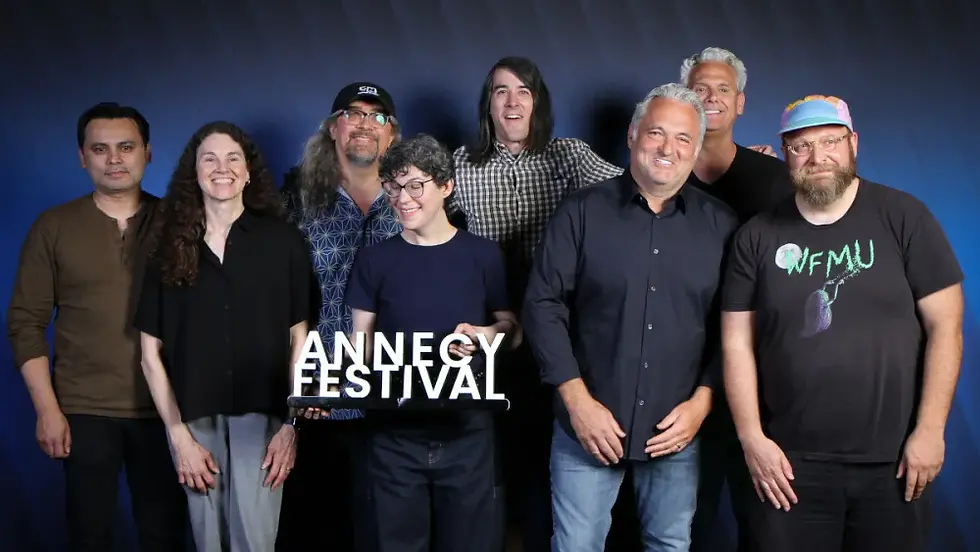
Annecy, the festival named after its host city, has established itself as the most important animation festival in the world. However, it is not immune to the potential complications arising from a governance crisis within the European Union, which could affect CITIA (Cité de l'image en mouvement), the organization behind the Annecy festival. CITIA's funding comes from various governmental and territorial bodies that centralize/regionalize the festival's objectives, tied to certain geopolitical interests of the state (which I am unaware of). Fortunately, CITIA has successfully built a highly strategic operational model that allows it to mitigate political influence in its planning and growth, thanks to the following elements:
Annecy serves as a significant tourist asset that generates substantial economic activity during the summer in the region and its surroundings (including Switzerland). As an international meeting point, the region's economy responds positively to the high influx of young people who seek not only to experience the festival but also to fall in love with the city.
It integrates national and international sponsors comprehensively into the festival's activities, highlighted by their promotional efforts and activations throughout the city.
It capitalizes on the North American market through various exclusive events sponsored by the largest studios and platforms in the world. In essence, it "rents" them the opportunity to have a spotlight at the most significant event in the industry globally.
As long as Annecy continues to bring economic prosperity to its region (regardless of the actual growth of the creative sector in Europe) and remains a focal point for the most important brands in animated content worldwide, I do not foresee any power (for now) that could challenge the governance of the festival. However, this does not make it innocent of inadvertently perpetuating Hollywood rhetoric among new artists and creators, rhetoric that, in my view, is causing more harm than inspiration in the development of creative and aspirational thinking among new generations.
Before the pandemic, the curation and official selection of the festival primarily benefited productions from the European Union and emerging industries with a mature proposal for the animation market. However, they have decided to fully embrace Hollywood studios and their productions, creating a clear incongruity between the festival's central message as a platform for independent artistic exploration and the aspirational message of Hollywood, which, given the current employability rate in the industry, seems ridiculous to me. You can find more about this discomfort in the following note from Cartoon Brew, which I believe adds several completely valid points to what I've just mentioned.
Once again, we are allowing the US to dictate to everyone what to do and how to do it.
Are they no longer just the world's police; now they are the police of animation production? Our economies, businesses, talent development, and access to resources are not the same. Why would we want to imitate them? In Europe and Asia, there is tremendous wealth in their local industries. Each has a production model and narratives so distinct that they are reflected in their national properties (which are not necessarily exported to America). Countries like France, Germany, Spain, Russia, Korea, China, India, and Japan, although some share borders or are just a step away from each other, each has its own local production model and very specific narratives.
In Mexico, we are experiencing a significant period of decentralization, where diverse voices are beginning to develop new creative meeting points throughout the Mexican Republic. Aguas Calientes joined the festival tours in 2026 with the FINAV, Monterrey is preparing its first creative market for the industry soon, and the ILUMA in Puebla, developed by Tec de Monterrey, along with its annual highlights in Mexico City, demonstrate sustained growth and the enormous community of students participating in their activities. This is incredible; we have a tour of professional activities in the Mexican Republic. This has never been seen before. The best part is that each one brings a different ideology, where, despite sharing a common heart, it is important for each to showcase a distinct piece of the puzzle in line with the observation of the industry's growth in Mexico. Because we cannot centralize the message of what the industry is in the country, nor allow an absolute perspective to exist on this matter.

For over a decade, the Pixelatl Animation Festival has been seen as the “Avant Garde” of animation events in our country, also recognized as one of the best in Latin America. I have emotionally experienced a personal evolution year after year by participating in its activities and business market. Without a doubt, for every Mexican in this field, those who have participated in its activities, benefited from its calls for submissions, or lived unforgettable experiences in its spaces, it is simply a symbol of the spirit we have in Mexico for creation.
Currently, it is impossible for me to separate the symbiosis between the Pixelatl Festival and the Government of the State of Jalisco. To be honest, this has caused me to view this event, to which I owe so much, with completely new eyes. Seeing how Pixel Quebec ended its operations due to a change in governance and economic objectives, obviously stemming from political changes in the state, raises the question: how secure are we that the policies and programs created by “Movimiento Ciudadano,” the orange party that governs Jalisco, will last forever? What would happen if MORENA (for instance) won the next elections and the innovation and support programs for creative industries, such as Ciudad Creativa Digital, were shut down to redirect resources to social programs, or simply because MORENA enjoys dismantling what the opposition has built for sheer pleasure? I am sure that this thought has never crossed the minds of many of you.
The reality of festivals that centralize their activities at the state level will always involve dependence on the government of the state in which they operate. This is the norm worldwide; no festival is exempt. There can be no growth in a cultural and creative ecosystem if federal and state governments do not get involved in its development; our cinema in Mexico also depends on this. Every six-year term in Mexico changes the show, and despite the current reality of the country, the industry has found ways to move forward regardless of who is in power.
Fortunately, our festivals have leaders who will make critical decisions that allow them to survive and continue bringing opportunities for all artists. To ensure this, it is crucial to "de-Americanize" the curation of these spaces in our country to a significant extent. Why?
A few years ago, while sitting in a row at a festival conference, something no longer clicked with me. What changed? The people I love in this industry are here; I am having a great time wandering around the event, but despite the joy of seeing my colleagues, my belief system, combined with the perspective I now have of the industry, is very different from what it was a decade ago.
Why do we insist so much on bringing American showrunners or directors to tell us Mexicans how to succeed? I greatly admire the figures who have come to inspire young creators with their life experiences; however, in Mexico, no one studied at CalArts, nor do we have the fortune to work in an ecosystem where a studio can provide an artistic growth program that allows artists to transition into directing or creating their own shows. Not even in the most experienced studios like Anima or Huevocartoon were these practices implemented—which, honestly, is what led them to where they are now. The creative anecdotes of these creators, the narrative thinking, and the structuring of a pitch for a project are indeed valuable tools that work the same way worldwide; I use them and even teach them as if they were the Ten Commandments of Moses. Although these messages may partially make sense, in the areas of professional development, job placement, the consolidation of an authorial voice, and connections with studios that enable the development of creators, we are in a different ecosystem. Therefore, we need to reform how we create original animated content in Mexico without trying to force ourselves to be like the United States.
What would I recommend to festivals and markets in this case?
If you are going to bring showrunners to give a conference, it should focus on production processes and team management strategies that can adapt to production processes in Mexico. Their life stories are very interesting, but that type of success cannot be replicated in our country, and placing so much emphasis on it is detrimental to the professional self-esteem of young creators. Because, guys, you are never going to be Danna Terrace; I’m really sorry.
We need more presence from digital brands that have jumped into animation through omnichannel strategies and content marketing. Strategic minds that teach young artists not only to draw characters but also to create a work structure and understand social media to generate audiences for their projects.
Incubation programs instead of pitching. In multiple festivals across Latin America, there are calls that allow creators to showcase their series and film projects to producers, executives, and industry specialists. All with the purpose of carrying out a "Festivaleo" that generates exposure for the projects and helps them connect with agents who can make their consolidation possible. I must admit that the "festivaleo" is like the "Vogue" of creating animation; it is the most glamorous part of this. However, in an industry where acquisition and production are very limited, I only find it valid to invest in festival participation if your primary goal is to showcase your work, network within the industry, understand the international ecosystem, and make meaningful connections.
Not everything can be about narrative, art, production, and exhibition. We need to bring more strategic, financial, and marketing skills to the table for creators so they can start developing their projects as digital properties autonomously (this won't apply to everyone; there will be projects that, by their nature, are exceptions). However, in my opinion, with all the bibles I review each year from people seeking my help, I see properties with enormous potential to start generating audiences without needing an animated pilot, series, or film, and without having to travel around the world seeking someone who can provide at least part of what their project needs to consolidate.
Finally, I would add as a monumental piece to the national B2B markets the need to transform them into literal markets. Pavilions filled with booths from brands, studios, talent, and national properties that highlight the national wealth in terms of sector development. Last year, when I was part of the Mercado de Destacado, I truly felt it was a phenomenal success to enter a space filled with everything being done in Mexico. It also allowed visitors from various professional categories to connect with what is "Made in Mexico."
Wait, I have one last point, but this is just my whim, okay?

There should be an animation festival and market on the beach, similar to MIPCANCUN, which is wonderful because it attracts the most important figures in international production. They take advantage of their trip to bring their families and enjoy a vacation in Mexico while attending the event—this follows the same economic tourism model as Annecy, but on a smaller scale. If there were a Latin American platform focused on our industry that had phenomenal tourist appeal, we could persuade many people to participate and come see what is being done in Mexico. MIPCANCUN does not have a specific section dedicated to animation; however, I have heard that there have been cases of industry attendees at the event. Although there is no verdict on whether this is worth it in relation to the opportunities given the high cost of the event, I will leave you with that to think about.
Outlining a development model with accessibility, commercial linkage, and autonomy in Mexico.
If you've made it this far, I sincerely appreciate your attention and reading skills. You are my champions. It means a lot to me that you haven't gotten upset along the way and dismissed my observations.
There are three “powers” that we can reorganize within the current animation ecosystem in Mexico, and we have absolutely everything we need to make it work.
The creator's ownership of their work (Creative Autonomy)
The minimum viable product (Digital Property)
Commercial linkage (Markets, Festivals, and Licenses)
Creative Autonomy:
The independence from a creator/studio relationship to exploit their work, either physically or digitally.
Before listening to the promises of a production house, an independent producer, or an investor, ask yourself the following question: Can I START on my own? Do I have the resources and skills that would allow me to kickstart the project? If the answer is yes, then do not grant rights assignment/options to anyone. This way, you can launch your own project with both physical and digital focus, working around a single social network while laying the foundations you want to maintain, which will be accessible to the audience from the beginning (there are agreements that freeze your ability to showcase the IP to the world). If you partner with a production house or animation studio during the early development stage, they will want to take control of the property, including its digital behavior, if you contractually allow it.
If you still want to make a rights assignment/option agreement with a production house because it offers good benefits for you or your team, do your best to maintain control over the project's digital presence so you can build an audience without needing their authorization.
Digital Property:
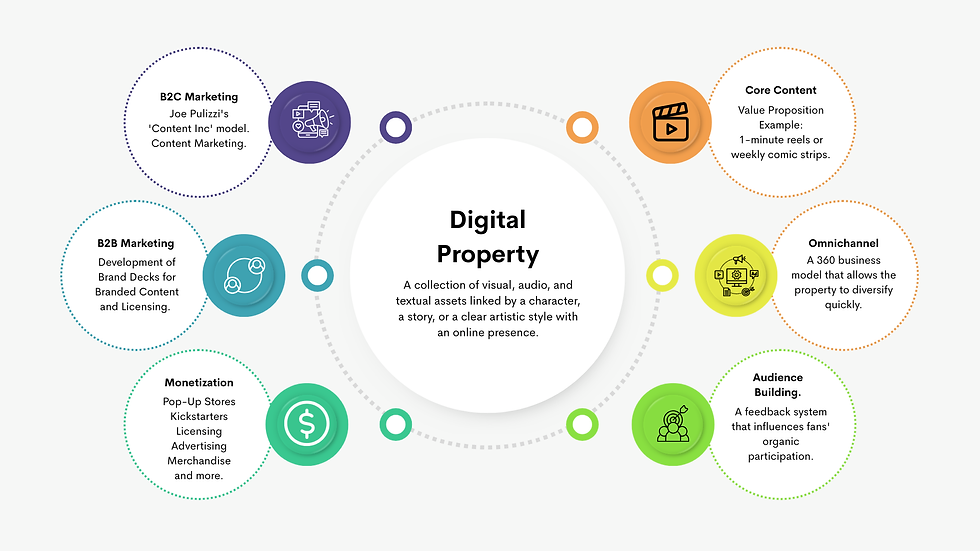
The collection of visual, auditory, and textual resources linked by a character, a story, or a clear artistic style with an online presence.
In this definition, I never mentioned “Animated Pilot”—you must think I hate them, but no, I just find them to be a senseless expense. Digital property can be an audiobook published online, a novel uploaded to Wattpad, a comic available on Webtoon, or even memes featuring a fun character on Instagram. I am talking about all the possible verticals through which you can start linking your work with different audiences, with all of them engaging from these various points of connection with you as creators. Many of you may know the musical “EPIC,” animated by “Neillustrator,” a storyboard and animation artist who decided to tell her vision of this story in an animatic format because it was the best way for her to start and create a minimum viable product. Despite not being a finalized animated production, it has many more followers and views (on loop) than high-quality animated projects. What is stopping you from launching an animatic instead of fully producing a series, under the same publication model? What matters is to advance the property.
Consolidating a digital property will enable you to activate omnichannel strategies early on. If your endemic audience is located in a specific city, you can organize meetings with them through various activities such as a “Pop Up Store,” a public comic reading, a book signing, or even collaborations with the local market in your city. Licensing agreements with emerging cafés, decorating party venues with your characters, and even renting your characters for promotional events at local stores are all possibilities. This way, you create a commercial digital footprint, establish business verticals, and even generate profit from just a few thousand organic followers on the platforms you are using. If you have the capacity to do this before linking the property with a studio, production house, or investor, you will have more tools to negotiate your participation as authors. In the event of a rights transfer or option, you can secure a substantial payment for “releasing” a piece of this product. By being “omnichannel,” it transforms into a property where each content category operates as an independent business. Because you won’t grant the animation studio control over the graphic novel. A digital property guarantees the creator the ability to assign and option their creations at will, without losing autonomy, as there are various product verticals in which they continue to work.
Commercial Linkage:
Any executive activity that involves the creator in a business ecosystem of production, exploitation, and exhibition.
The shift in focus to Digital Property opens up a dozen new possibilities for bringing your project to the attention of key figures for its growth. It is no longer just about animation festivals or markets; it also includes brand fairs, toy manufacturer expos, licensing expos, fashion expos, and more. All categories within business events that involve brands, creativity, and product development. Animation festivals in Mexico do not attract toy manufacturers, brand licensors, or even representatives of industrial property. Why don't we have these individuals in our country when Mexico has an undeniable wealth of ideas with global commercialization potential, and these figures could help us understand how to position ourselves better? They are not necessarily looking for products with animated content; they seek products that have created a significant audience to which merchandise, services, or something else can be sold. Yes, the production of entertainment such as films and series, regardless of the format, is of great assistance; however, the quality, volume, or even the exhibition platform become secondary. Have they forgotten about the “Italian Brainrot”? Their main point of viralization was on Roblox, and without a title or trademark registration (being a very unusual case of public domain), they became the best product for piracy and local manufacturers in our country.
I don't believe that the “Italian Brainrot” could have been created by a specific figure; they are a vortex of viral modifications and internet memes. However, if they had “copyright,” the brand owner would currently be a multimillionaire due to a digital property that the audience has done all the work to multiply its value, primarily on Roblox. If anyone has any updates regarding the status of the rights to these characters, please let me know so I can update this information.

The mexican animation industry needs to connect with the consumer brand industry and reach mass audiences.
I have unleashed venom – I won’t deny it – towards many organizations, festivals, and companies that, in my opinion, do not understand at all how the global ecosystem is behaving and continue to insist on doing everything strictly according to the orders from North America. As a professional industry, we remain stuck in the notion that our companies survive by offering services abroad, where we have defended ourselves quite well both in terms of talent and customer relations (Canada is in a similar situation according to my sources there). There are also production houses that basically rely on government incentives and production grants year after year. Both profiles have the infrastructure to produce digital properties, but they are fixated on creating pilots, shorts, or animation tests that do not guarantee the creation of a product that allows them to establish a long-term business vertical. Anima Studios produced seven films in “Las Leyendas” and a high-quality series available on Netflix. This occurred over nearly 20 years.
Tell me, in all those 20 years, do you know the names of the characters in the franchise? When did this property even come close to achieving what Huevo Cartoon accomplished in the early 2000s? Where were the brand collaborations, the licensing agreements, the product development with national manufacturing, or even the studio's own investment to position the characters outside of the cinema? In twenty years of producing film after film, they never allocated strategic support to develop the property as a consumer product that could thrive in various categories outside the screen. Did they not care, did they not know how to do it, or was the problem simply something beyond their control?
Honestly, I no longer believe we will know.
For that reason, I needed to delve into Licensing to understand what is happening in Mexico that we are so disconnected from the world of consumer brands derived from characters. Therefore, I plan to use my 10 years of experience in this industry to find that missing link our country needs to generate an ecosystem of brands derived from animated projects and create more Dr. Simis in the country. We are allowing the Asian market and its "kawaii" characters to take over Mexican consumers because we lack brands capable of competing with them or even collaborating with them to strengthen their presence in Mexico.
Mexican Tax Credits for... Licensing?
I’m going to talk about a crazy idea I had a couple of years ago that I really haven’t done anything with; it’s just been living in my mind “rent-free.”
The famous “Tax Credits” are economic incentives that help production companies and animation studios worldwide minimize their tax payments on the total production cost, as long as the production takes place in the country of origin. I learned about this fiscal exercise during my visit to Cartoon Connection in 2016. All the studios were eager to utilize it to gain benefits of up to 30% of the total production cost, allowing them to invest in studio development, original properties, or start their next project.
Tax Credits benefit creative industries by generating wealth and jobs within their own territory (which is why you won't be hired at a foreign studio using these tax incentives; they must pay salaries to local citizens). Currently, in Mexico, these same benefits can be accessed through FILMA JALISCO, which encourages state productions, and CANACINE, which benefits national productions. All of this pertains to film production.
Animation can also benefit from these incentives if the workforce and production services are contracted within the territory.
Alright, we now have a general understanding of Tax Credits. What if we created a similar fiscal exercise within the brand and licensing market?
One thing I’ve encountered when approaching licensors/retailers like Liverpool in Mexico is their clear attachment to North American brands (primarily everything generated by Disney and Marvel) because it guarantees them a high volume of sales and merchandise turnover. For them, the benefit lies directly in shelf sales and the demand for specific product categories. This demand changes with seasonality. The shifts in consumption trends among children and young people, the transition between fashion seasons, and the back-to-school season (which is a significant focus for licensors), among other factors, are indicators of merchandise movement and consumer behavior in Mexico.
Mexican companies have no real incentive to work with Mexican properties. If you wanted to partner with a large retailer like Liverpool, or even a basic basket product (like LALA milk featuring Bluey on its packaging), you would need to have a highly diversified industrial property monster with 10 years in the market or be Dr. Simi. In that case, you might need to target smaller businesses and well-positioned national manufacturers (like the agreement I managed to close between Cinema Fantasma and Chahneke). However, rejection can still occur in that sector since they will prefer to pay Disney for Spider-Man—knowing it will sell—even if the minimum guaranteed payment for using the assets is exorbitantly high—rather than pay you for your characters (even if you have an account with hundreds of thousands of followers).
If the tax authorities provided any fiscal benefits to these companies for working with Mexican properties, a system very similar to Tax Credits but applied to the manufacturing, distribution, and marketing of national products, I believe we would have a better opportunity for our digital property to hit the market across various categories. Just as the new film laws have positively impacted the number of Mexican films in exhibition, it doesn’t seem illogical to envision a future where consumer brands join this trend of developing national products with national properties. This transformation can occur if we create a remarkable ecosystem of consolidated projects as omnichannel digital properties with a presence in Mexico.
We urgently need to activate this digital property economy in our country.
The United States is gradually beginning to see its “downfall” as an empire, and amid this social and economic collapse, the entertainment industry is being caught in the crossfire. The biggest red flag for me occurred just this year (in addition to the massive layoffs, strikes, and lack of job opportunities); this was the closure of operations of the world’s most important children’s animation market known as “KIDSCREEN.” For 26 years, it was a major business event that allowed studios to gain opportunities to thrive. The relationship between Gasolina Studios and Arcana Studios, which enabled us to create “My Brother the Monster,” was born within the walls of that event. Now, with the market constantly declining, having fewer buyers, fewer distributors, and fewer studios—many of which are starting to merge and acquire one another to survive and be profitable in the stock market—this has caused the event to lose its meaning for the organizers, who announced just a few months ago that last February was its final edition.
You need to know something. They don’t want our stories in North America; they are going through an era filled with racism and xenophobia that has permeated the content market to the extent that even a figure as prominent as Jorge Gutierrez has difficulties getting his projects made due to the clear voice of his roots in his work (he is very open about this on his social media). It frustrates me to see creators wanting to sacrifice ownership of their projects for crumbs. It angers me to continue seeing national festivals filled with guests from Los Angeles, who honestly contribute nothing more than the glamour of seeing a nice behind-the-scenes look at some high-level production.
Entering the international job market from Mexico is currently impossible. Those Mexicans who managed to position themselves in studios in Canada, the USA, or Europe took advantage of the pandemic, which initiated a hiring boom and visa approvals because all studios grew absurdly during that period and had many financial and fiscal facilities to operate remotely. Currently, to obtain a work visa, you really need to be a unicorn; you must have something extremely unique that justifies the expense any company will incur to bring you to their offices.
We are at a very interesting breaking point that will cause various studios to disappear and new proposals to emerge. Amid all this birth of new business models and studio cultures, I hope that digital property becomes part of the creators', producers', and executives' objectives. They need to invest strategically in omnichannelity and stop doing things the way they have for the past 20 years if they want to leap to a level that old studios in Mexico never could reach.
We have more talent in our industry than we have ever had. More and more universities are adding multimedia, animation, and special effects degrees to their curricula. Unfortunately, we do not have a viable employment rate for the thousands of students who join the creative industries' job market year after year. Something needs to change for that to improve, and I believe shifting the economic development focus of studios to the creation of digital property could be a key factor in this.
What will I do with this information in the coming years of my life?
When I turned 21, one of my best friends asked me where I saw myself in 10 years, to which I replied, "In the place where I want to be for the rest of my life"—at that time, I aspired to join Pixar Animation Studios, unaware that I would be at the helm of my own animated series—but the point is that at 31, I found the place I want to be forever.
Now that I am 37 and rethinking my personal and professional goals, triggered by all the paradigm shifts I mentioned earlier, I have decided to make efforts in Mexico to achieve synergy among animated pilots, consumer brands, audiences, and the licensing world within the local market. Because nothing would make me happier than finding products from series made in our country everywhere, even in an Oxxo store.
To do this, I first need to understand how the rules of the game work at the Americas level, then understand other ecosystems like Europe and Asia, which I have already done in animation, but now I must repeat in another creative sector (and at a much faster pace). Collaborating with projects like "Claynosaurz," for which I am officially the licensing agent in Mexico, will provide me with the tools to catapult this ambition and find ways to make this system of content, licensing, marketing, and creative autonomy work in Mexico.
I don’t want to depend on major US studios to take the first step in seeing my animated project solidify on a streaming platform. I want them to be the last step, with everything built organically in our region, with an endemic audience served by a brand, whose transition to animation is the result of the success of various business verticals.Dr. Simi represents the standard to beat, because I am sure we can surpass it.
Finding private investors for an animated project is a brutally difficult mission; however, securing investment for the development of an idea with omnichannelity and a realistic return on investment is much more attractive if you have the creative tools, education, work team, and strategic vision.I hope this reading has left you with something to think about. If you felt frustration, anger, excitement, or anxiety, it means something within you resonates with everything I mentioned earlier, and that’s what it’s all about. Because, in the end, the one making decisions is our gut, but we need to stop ordering the same thing on the menu over and over again.
Don’t forget to share this article everywhere; I would greatly appreciate it reaching as many people in our industry as possible. Feel free to leave comments, hate, whatever you want to express.

Comentarios